Switzerland and the EU: better and more predictable relations
The Federal Council approved a package of new and revised cooperation and market access agreements negotiated with the European Union. Ultimately, it will be up to Parliament and, in the event of a referendum, voters to approve the deal.
Switzerland and the EU have a long history of close cooperation. And while Switzerland might look like a solitary island in the middle of Europe, it shares many goals, values and policies with the 27-nation bloc.
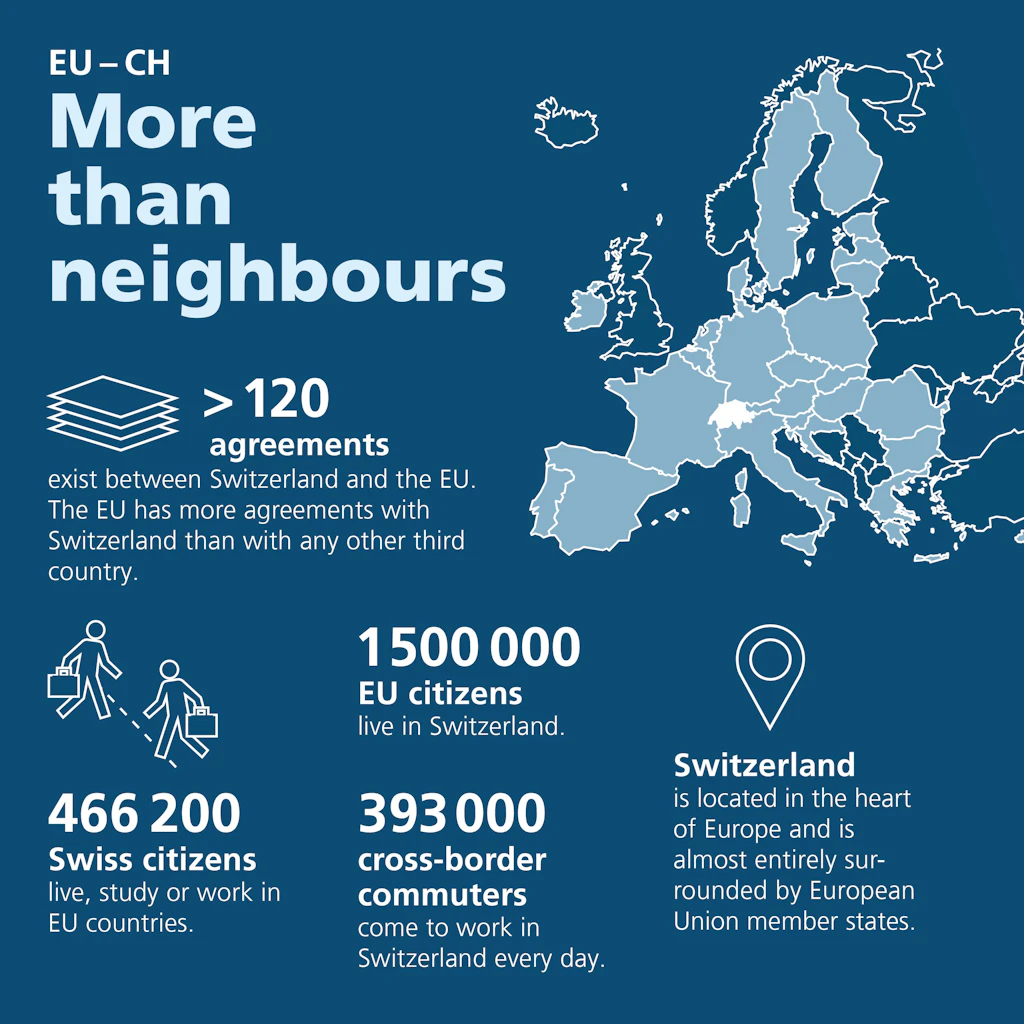
Over the past 50 years, Switzerland and the EU have agreed on more than 120 bilateral deals to ensure smooth relations in areas such as trade, transport, security and education. In 2023, the two parties decided to pursue a package approach for future cooperation. The Federal Council is convinced that this approach will ensure the stabilisation and further development of bilateral relations with the EU.
After almost 200 rounds, negotiations were materially concluded in December 2024. The Federal Council determined that the objectives set out in the Swiss negotiating mandate had been achieved – thus paving the way for the implementation of the package strategy.
On 13 March 2026, the Federal Council approved the dispatch to Parliament on the stabilisation and further development of Swiss–EU relations package (Bilaterals III).
Video explainers
Switzerland and the EU have negotiated a new package of agreements because the current ones are over 20 years old, and in need of an update.
The existing internal market agreements under ‘Bilateral I’ have been updated and three new ones have been negotiated in the areas of electricity, healthcare and food safety.
The Federal Council supports the negotiated package because it will provide more security, prosperity and opportunities for the Swiss population. The Switzerland-EU agreement package will stabilise and further develop the proven bilateral approach with the EU.
Switzerland and the EU have negotiated a new package of agreements. What does it contain? The package includes not only agreements, but also measures for their implementation in Switzerland, with accompanying measures where necessary.
The package has two parts: one aims to stabilise the bilateral relationship by preserving existing agreements and regulating access to EU programmes and Switzerland's contribution to the EU on a long-term basis.
The other part aims to develop the bilateral path through three new agreements on electricity, health and food safety.
The agreement on the free movement of persons regulates the conditions under which European citizens can come to work, study and live in Switzerland, and vice versa. It has been adapted in the package of agreements negotiated between Switzerland and the EU.
One of the adaptations concerns the new ‘safeguard clause’. Switzerland will be able to pull this handbrake quickly and autonomously if immigration from the EU causes serious difficulties.
To activate it, Switzerland will have to refer the matter to the Joint Committee and, if necessary, to an arbitration tribunal. If the EU does not agree, it may take proportionate rebalancing measures.
Switzerland and the EU have added so-called institutional elements to all market access agreements. These include the dynamic adoption of legislation and the interpretation and surveillance of the agreements. They also guarantee that the agreements will be updated regularly.
These institutional elements will allow the bilateral approach to continue. They create legal certainty, equal treatment and a level playing field for companies and individuals within the internal market.
Switzerland wants to stabilise and further develop its relationship with the EU. It intends to expand its relations in a targeted manner via new agreements on electricity, health and food safety.
The electricity agreement with the EU will secure the Swiss grid’s stability and make it easier for Switzerland to exchange and trade electricity with EU nations. This will bolster grid operation while securing the supply and promoting competitive electricity prices. The result will be gains in efficiency for the economy and an increase in prosperity. Public services will remain fully guaranteed.
In order to protect wages in Switzerland, the Federal Council has agreed on a three-stage safeguard mechanism with the EU. It includes:
the principle of ‘equal pay for equal work in the same place’ and the Swiss control system designed to enforce it;
exceptions negotiated by Switzerland (including a prior notification period for high-risk sectors and a deposit requirement for unpaid fines);
the ‘non-regression clause’ (no adoption of any new EU laws that weaken wage protection).
In addition, together with social partners and the cantons, the Federal Council has developed a package of domestic measures.
The Switzerland-EU package includes a new cooperation agreement on health. In concrete terms, it provides greater protection, better preparedness and closer cooperation with the EU in the event of a health crisis.
The health agreement is part of the Swiss-EU package that allows for the development of relations. It can only enter into force if the stabilisation package, which guarantees the future of the bilateral approach, is accepted.
For the internal market agreements between Switzerland and the EU to function properly, they must be updated regularly. Dynamic alignment makes this possible.
This is in the interests of both Switzerland and the EU and enables companies to plan their activities and investments with confidence. Dynamic alignment preserves Switzerland's independence, sovereignty, direct democracy and federalism.
Regulations can pose a challenge for the economy. However, harmonised rules between Switzerland and the EU under internal market agreements often bring advantages for businesses.
Thanks to the agreements with the EU, Swiss companies can export many goods to the EU more easily and hire European staff as needed without much administrative hassle.
Since 2007, Switzerland’s contribution has helped to promote stability and cohesion in Europe – two key prerequisites for a well-functioning EU internal market, in which Switzerland participates.
Specifically, Switzerland has supported hundreds of projects in the areas of environmental protection, vocational training, social services, healthcare, and migration.
Under the new agreements, Switzerland’s contribution will become regular and amount to CHF 350 million per year from 2030 to 2036. As is already the case today, the funds will not be paid to the EU directly. It will continue to be invested in projects selected by Switzerland in collaboration with its partner countries.
Switzerland and the European Union want to create a common food safety area. The new protocol on food safety supplements the existing agricultural agreement. It also covers plant-based foods such as nuts, cucumbers, and pasta, and strengthens protection against unsafe foods.
Switzerland will gain access to important EU food warning and cooperation systems. This will help identify risks earlier and remove dangerous products from the market more quickly. Consumer, animal and plant health will all improve.
The Swiss economy would benefit from the package of agreements between Switzerland and the EU. But how significantly?
To answer this question, the Federal Council commissioned five external studies on the following topics: electricity, research, MRA medical devices, partial adoption of the EU Citizens Directive, and discontinuation of Bilateral Agreements I. Certain assumptions had to be made for these studies.
The studies show that in various ways, the package would have a positive impact on the Swiss economy. The biggest positive effect would be achieved by securing the existing bilateral agreements.
Contents of the package deal
The package approach negotiated by the Swiss and EU teams covers a range of cooperation and market access agreements that benefit employees, consumers, students and researchers – in other words, society as a whole. In short, both the EU and Switzerland want to improve the quality and the predictability of their relations while boosting Europe’s competitiveness and position in the world. And in view of the current geopolitical challenges, solid bilateral relations help strengthen the entire European continent.
In the interactive graphic below, you can click 👇 on the hexagons for details on each topic.
A desirable partnership
Switzerland is an attractive partner for the EU. Here are some key Swiss assets that contribute to Europe’s quality of life and future prospects:
With its excellent infrastructure and central location in the heart of Europe, Switzerland provides an efficient route for cargo and passengers crossing the Alps. The three base tunnels of the New Rail Link through the Alps (NRLA) are the core of Europe’s main north-south rail freight route. By investing CHF 22.8 billion in the project, Switzerland has significantly increased capacities for environmentally friendly freight transport and smooth trade in the EU single market.
Thanks to its geographical situation in the heart of Western Europe and its ability to store electricity via its hydropower plants, Switzerland is well-placed to contribute to the stability of the European power supply. As a hub between northern and southern Europe, Switzerland plays a key role in preventing European blackouts.
Constitutionally obliged to promote scientific research and innovation, Switzerland has a long tradition of research cooperation with the EU and its predecessors. The European Commission and Switzerland both want to deepen this successful cooperation.
The lives of Swiss and EU citizens are closely entwined. Over 1.5 million EU citizens live and work in Switzerland, and 466,200 Swiss nationals are in the EU. In addition, both the European Commission and Switzerland want to grant their citizens and businesses fair conditions for providing services for up to 90 working days per calendar year – including the posting of workers.
With the dynamic adoption of legislation, wage protection for posted workers is ensured. A key principle is the ‘same pay for the same work in the same place’. The level of wage protection in Switzerland is high and should remain so. This is also in the interest of EU citizens working here. Switzerland and the EU have therefore agreed to safeguard some special features of Swiss wage protection (more details in this factsheet on wage protection).
For EU citizens, the Swiss job market is very attractive. With some 393,000 cross-border commuters and posted workers, there’s hardly an EU country providing so many career opportunities as Switzerland does in relation to the size of the native population.
The newly-designed safeguard clause – which Switzerland can trigger independently – is a tool for coping with any serious economic or social problems arising from the Agreement on the Free Movement of Persons.
Switzerland supports EU countries with financial aid as well as expertise. For the 2019-2029 period, it has earmarked CHF 1.102 billion for these 13 countries that joined the EU after 2004: Bulgaria, Croatia, Cyprus, the Czech Republic, Estonia, Hungary, Lithuania, Latvia, Malta, Poland, Romania, Slovakia and Slovenia. The focus is on vocational education and training. Another CHF 200 million will be used for migration-related measures in countries particularly affected by migration.
For the 2030-2036 period, the Federal Council agreed to an annual payment of CHF 350 million to help fund joint projects in partner countries which also address shared challenges such as migration. As part of its cohesion contributions, Switzerland has also undertaken to pay an additional CHF 130 million per year from 2025 until the end of 2029.
Switzerland also contributes to the promotion of peace, stability and security in Europe. For example, Switzerland has a long-standing development cooperation with non-EU countries in Eastern Europe and the Western Balkans.
Switzerland also shares EU values regarding Russia’s military aggression against Ukraine. Besides adopting EU sanctions against Russia and Belarus, Switzerland provides humanitarian aid on the ground in Ukraine and special protection status for those fleeing the conflict. By organising the Ukraine Recovery Conference (URC) in Lugano in July 2022, Switzerland has also made an important contribution to coordinating long-term reconstruction efforts.